One of the most common mistakes people make when booking group accommodation is underestimating how much space their group actually needs. This group accommodation space guide helps you understand what truly makes a stay comfortable for large groups.
A venue that looks spacious in photos – with sweeping lawns and elegant dining rooms – can feel very different when 30 people are eating breakfast together, or when several families are sharing one bathroom during the morning rush.
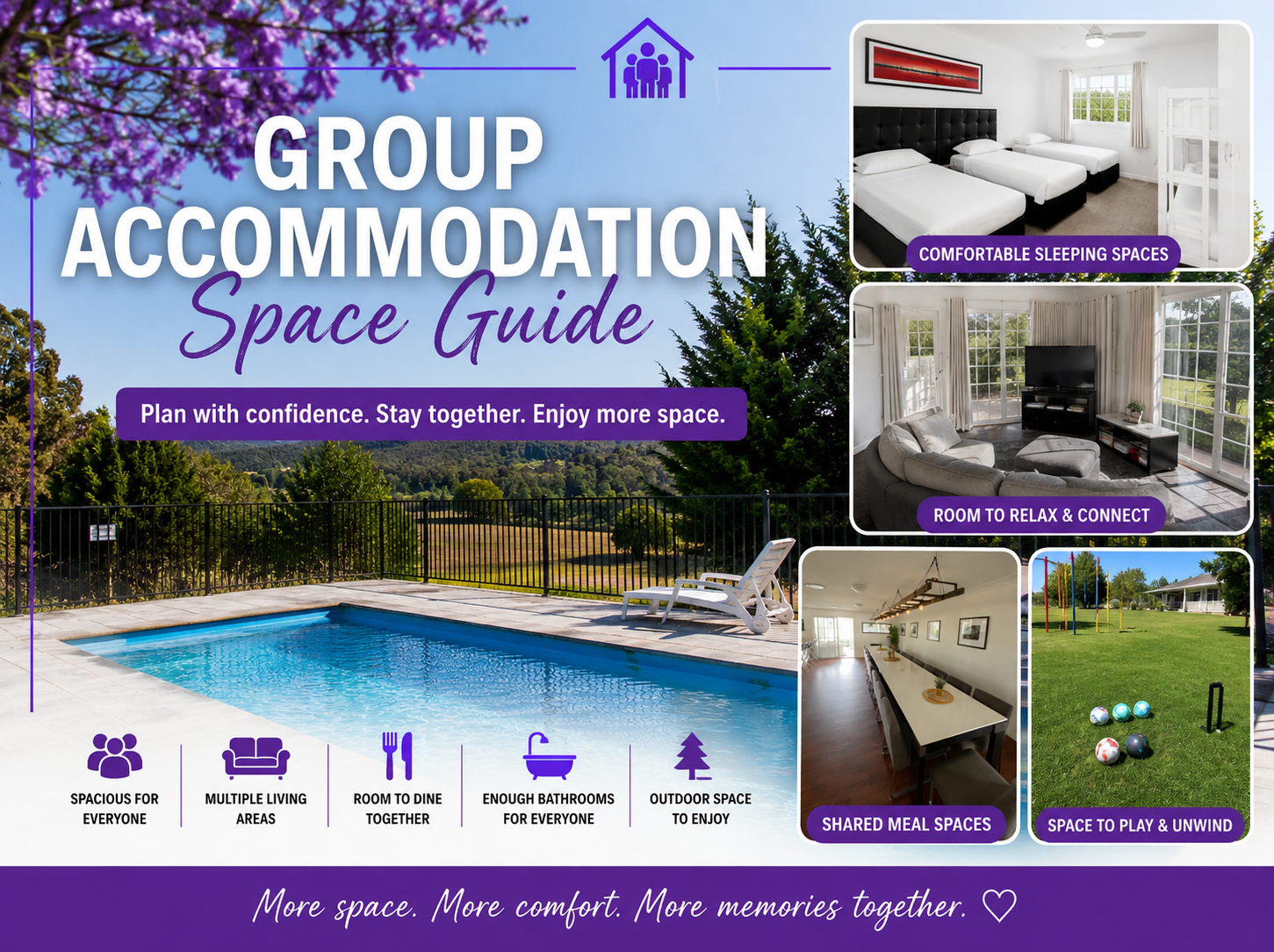
Getting the space equation right is the difference between a group stay that feels relaxed and generous, and one where people are constantly in each other's way. This guide walks you through exactly how to assess whether a group accommodation truly has enough space for your group – before you book.
Why Every Group Accommodation Space Guide Should Focus on Space Planning
When you book a hotel room for two, planning is simple. Group stays are very different, you need enough sleeping space for everyone.
You also need room for shared meals and group activities. Think about where 25 people will eat together. Think about where children can play during rainy weather. Adults also need quiet spaces to relax and talk.
Bathrooms matter too, especially during busy mornings. Everyone should have enough time to get ready comfortably.
Space in group accommodation operates on multiple levels simultaneously:
- Sleeping space – enough beds of the right type for everyone
- Communal space – areas large enough for the whole group to gather comfortably
- Outdoor space – room to move, play, and breathe outside
- Private space – corners of the property where individuals or smaller family units can retreat when they need a break from the group
A venue can be technically adequate on sleeping numbers but completely inadequate on communal space – and that mismatch will define the quality of your stay.
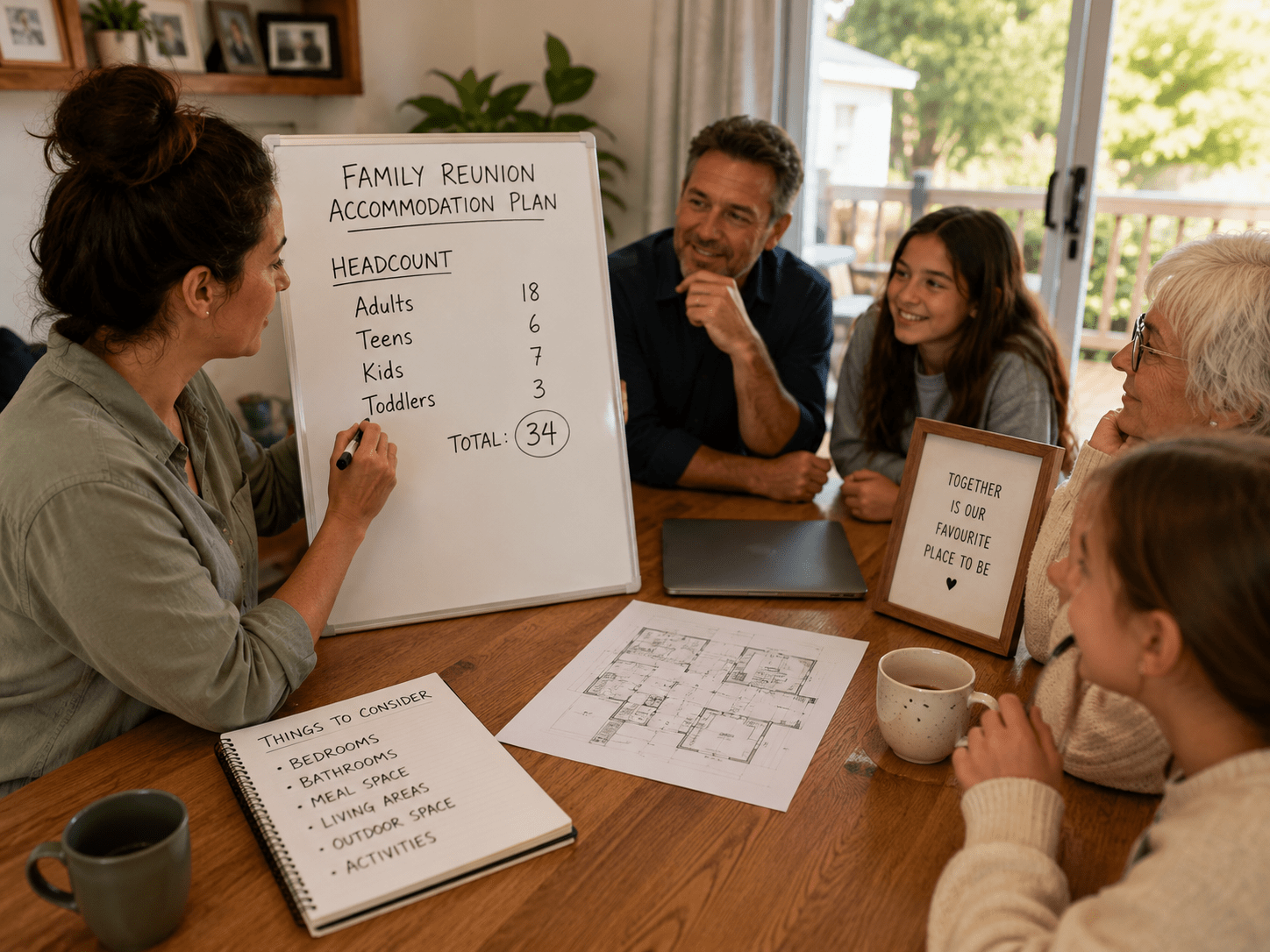
Step 1: Start With Your Actual Headcount
This sounds obvious, but it's where many bookings go wrong. Group sizes tend to grow between initial enquiry and arrival date – especially for family reunions and milestone celebrations. Before you assess any venue, nail down a realistic headcount that accounts for:
- Confirmed adults
- Children (and their ages – a toddler and a teenager have very different space needs)
- Any guests who may join for day visits but won't be sleeping over
- Support workers or carers who need their own sleeping arrangements
Once you have a solid number, add a small buffer. Booking a venue that sleeps exactly your group size leaves no flexibility. A venue with a little extra capacity means you're comfortable rather than crammed, and can absorb a last-minute addition without stress.
Step 2: Assess Sleeping Capacity Properly
Venue listings can be misleading when it comes to sleeping numbers. A property that claims to sleep 20 guests might achieve that figure by counting sofa beds, air mattresses, or trundle beds tucked away in hallways. That's not the same as 20 people sleeping in proper beds.
When assessing sleeping capacity, ask:
- How many guests sleep in real beds (king, queen, or single)?
- Are any of the listed beds sofa beds, fold-outs, or rollaway beds?
- What is the bed configuration in each room – couples sharing, or can beds be separated into singles?
- Are there family rooms where parents and children can share a space without booking two separate rooms?
- Is additional sleeping capacity available – such as a separate cottage or adjoining property – if your group grows?
For a group stay to feel genuinely comfortable, every adult should be sleeping in a proper bed. Children in bunks or singles are generally fine – but no adult guest should be on a sofa bed unless they've specifically requested it.
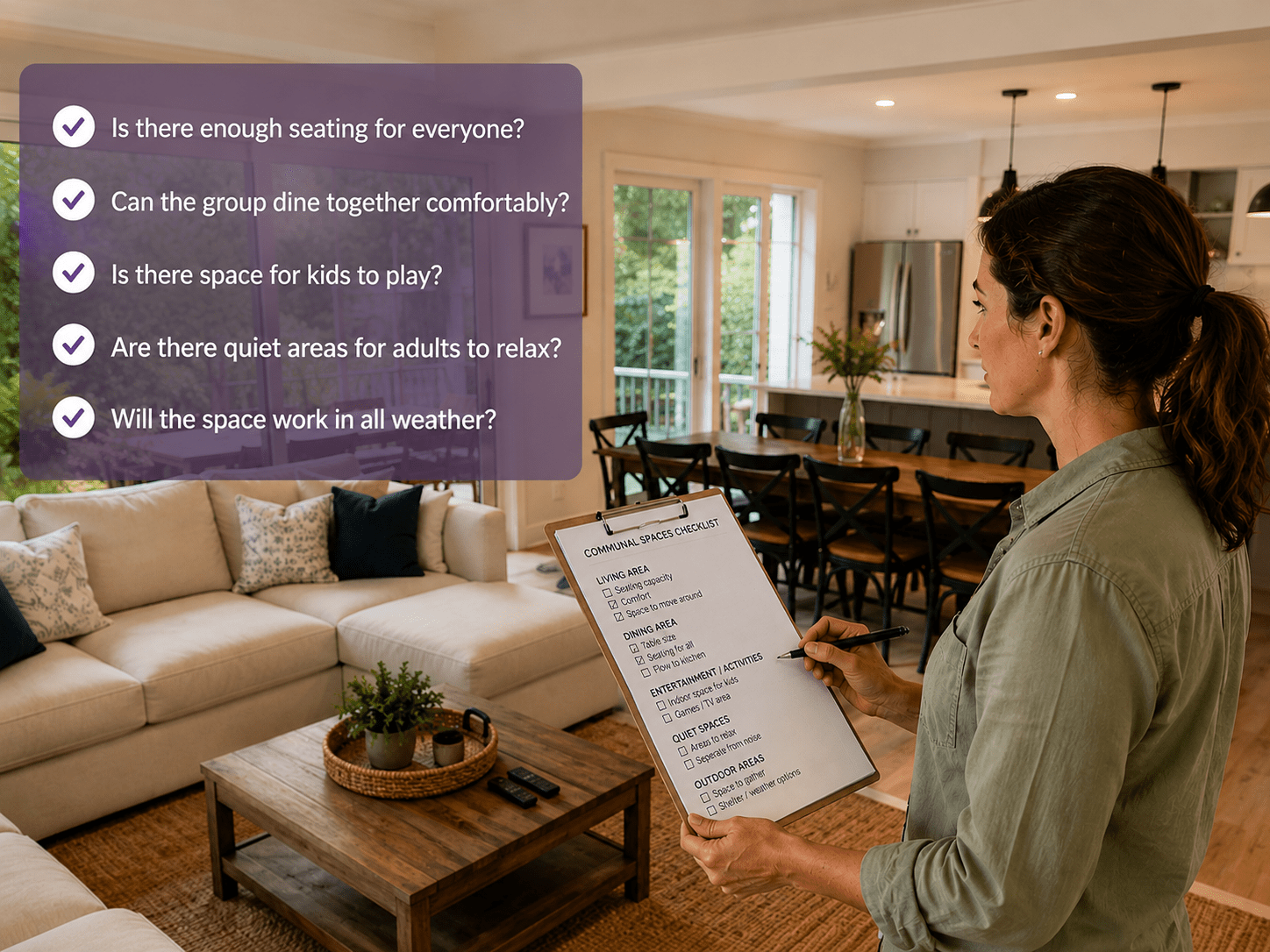
Step 3: Evaluate the Communal Spaces
This is where most group accommodation falls short, and where you need to be most rigorous in your assessment.
Dining space is the first thing to check. Can the whole group sit down and eat together at one table, or does the dining area only fit half the group?
Having to eat in shifts is one of the surest ways to undermine the communal spirit of a group stay. Look for a venue with a dining table – or multiple tables that can be combined – that seats your entire group at once.
Lounge and living areas should be large enough for the group to gather without feeling overcrowded. Count the seating. If a lounge has enough seating for 12 people and your group is 30, people will be uncomfortable during group activities, movie nights, or evening conversations.
Kitchen capacity is often overlooked. A domestic kitchen with a single oven and four-burner stovetop is genuinely inadequate for cooking for 30 people. Look for venues with commercial-grade kitchens – multiple ovens, large bench space, industrial fridges – that can handle large-scale meal preparation without chaos.
Hallways and circulation space matter more than people think. In a group stay, people are constantly moving through the property – to the bathroom, to the kitchen, to the outdoor areas. Narrow corridors and bottleneck entry points create daily friction. Look for properties with generous circulation space and multiple access points between areas.
Step 4: Don't Underestimate the Importance of Outdoor Space
Outdoor space does a huge amount of work in a group stay, especially when the group includes children. A large outdoor area gives kids somewhere to run and burn energy, which in turn gives adults the space to relax and converse without constant interruption.
Look for:
- Lawn area large enough for group games, cricket, or just lounging on a rug
- A pool – invaluable for warmer months and a natural gathering point for the group
- Covered outdoor dining or entertaining areas so the group can be outside together even in variable weather
- A firepit or outdoor seating for evening gathering – some of the best moments in a group stay happen around an open fire after dinner
- Enough sun loungers, chairs, and outdoor furniture for your full group
A venue that looks generous indoors but has a small courtyard as its only outdoor space will feel constraining, particularly for a multi-day stay.
Step 5: Think About Bathroom-to-Guest Ratio
Bathrooms are the hidden pinch point of group accommodation. Even the most spacious property can feel cramped if 30 people are sharing two bathrooms in the morning.
As a rough guide, look for a minimum of one bathroom per 6–8 guests. More is better, and the distribution matters as much as the number – bathrooms spread across the property (ground floor, upstairs, near the pool) reduce congestion far better than several bathrooms clustered in one area.
Also check whether bathrooms are ensuite or shared. A mix of both tends to work well in group settings – couples or families with an ensuite have privacy, while shared bathrooms serve the rest of the group.
Step 6: Consider Private Space as Well as Shared Space
In any group stay longer than a single night, individuals and family units will need moments of retreat from the group. This is normal and healthy – even the most sociable people need to decompress sometimes.
A well-designed group accommodation property offers pockets of private space: a quiet reading corner, a separate sitting room, a garden bench away from the main lawn. These spaces allow guests to recharge without having to leave the property, and they reduce the tension that can build when large groups are in close proximity for extended periods.
When assessing a venue, look beyond the main communal areas and ask: where would someone go if they needed 20 minutes alone?
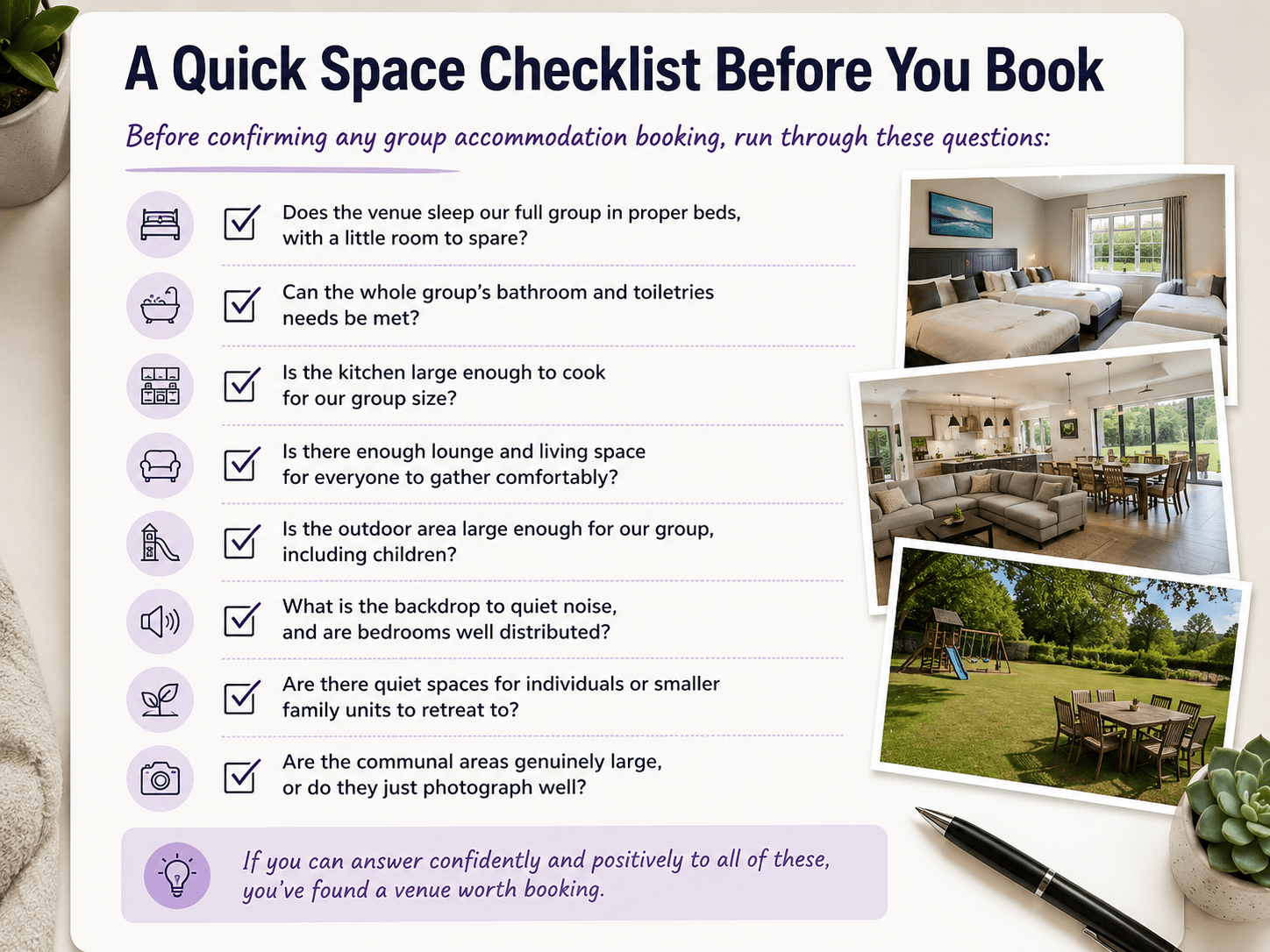
A Quick Space Checklist Before You Book
Before confirming any group accommodation booking, run through these questions:
- Does the venue sleep our full group in proper beds, with a little room to spare?
- Can the whole group sit down and eat together at one table?
- Is the kitchen large enough to cook for our group size?
- Is there enough lounge and living space for everyone to gather comfortably?
- Is the outdoor area large enough for our group, including children?
- What is the bathroom-to-guest ratio, and are bathrooms well distributed?
- Are there quiet spaces for individuals or smaller family units to retreat to?
- Are the communal areas genuinely large, or do they just photograph well?
If you can answer confidently and positively to all of these, you've found a venue worth booking.
How Berrima Retreat Handles Space for Large Groups
Berrima Retreat in the Southern Highlands of NSW was built from the ground up to handle large groups comfortably – not just adequately.
The Berrima Mansion sleeps up to 55 guests overnight across 11 generous bedrooms, all in proper king and king single beds – no sofa beds, no fold-outs. With 7 bedrooms on the ground floor and 4 upstairs, including multiple family rooms where parents and children can share comfortably, the sleeping arrangements flex to suit the makeup of your group. An adjoining cottage adds further capacity for larger gatherings.
The communal spaces are genuinely large. The dining area seats the full group together, the media room accommodates everyone for a movie or a group session, and the kitchen is a commercial-grade setup capable of handling meals for 55 guests without strain.
Outdoors, the private estate provides extensive lawn space, a pool, a BBQ and firepit area, a kids' arena, and room for sports and group games – all within a secure, fenced boundary. With 8 bathrooms spread throughout the property (including a pool shower), the morning rush is never the ordeal it can be at other venues.
And because every booking is exclusive use, your group has all of this space entirely to themselves – no other guests, no shared areas, no strangers at the breakfast table.
Located just 90 minutes from Sydney and Canberra in the heart of the Southern Highlands, Berrima Retreat is ready for your group.
See It For Yourself
The best way to know if a venue has enough space for your group is to get the full picture before you book. Download the free Berrima Retreat info pack at www.berrimaretreat.com.au, it includes full floor plans, room layouts, bed configurations, and everything else you need to assess whether the property is the right fit.
If you have specific questions about capacity or space, the team is always happy to talk it through directly.